***
title: Conditions & Branching
sidebarTitle: Conditions & Branching
description: Create dynamic conversation paths based on caller responses.
-------------------------------------------------------------------------
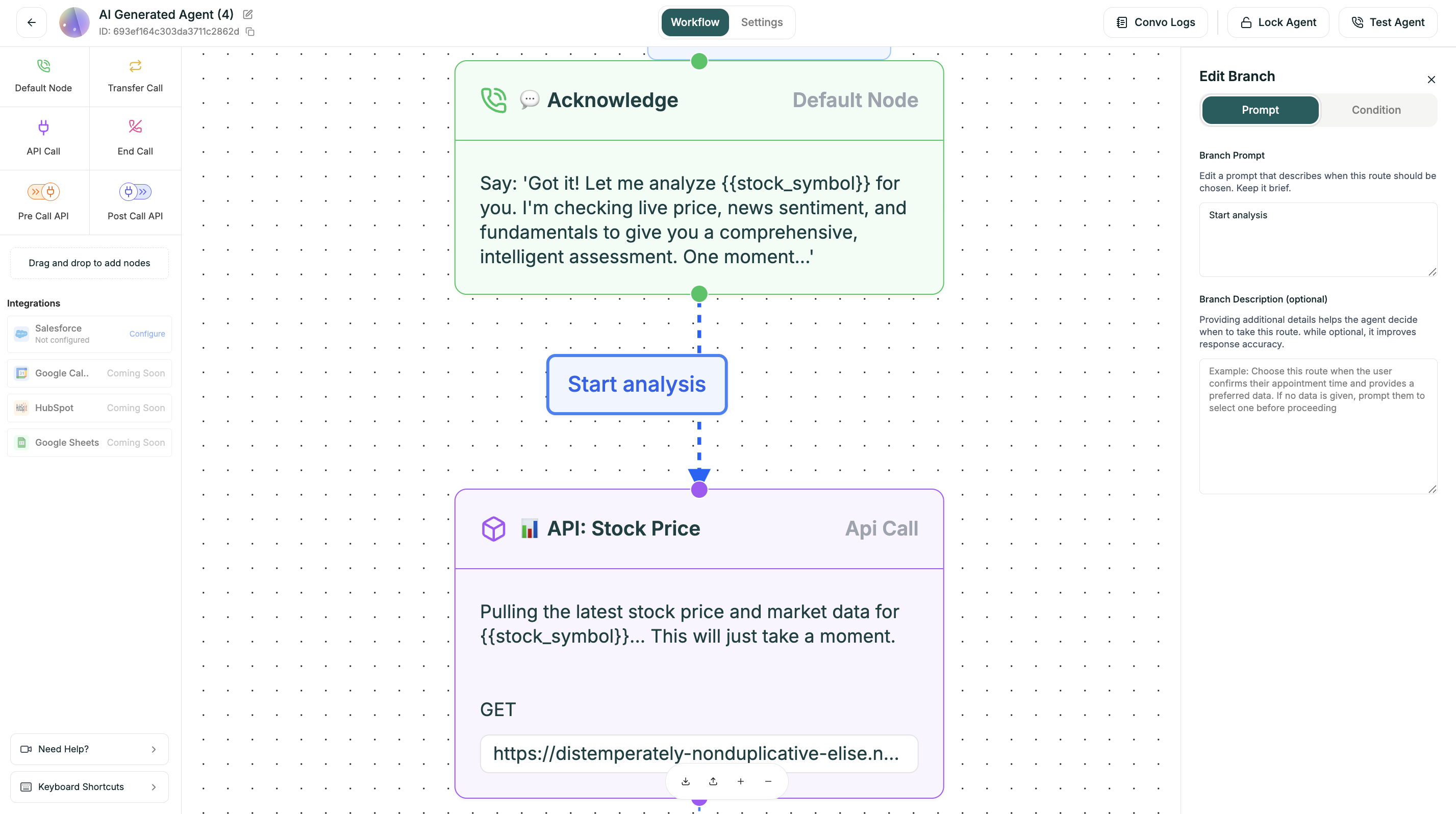
Branching is what makes Conversational Flow powerful. Instead of a linear script, your agent can take different paths based on what callers say, how they respond, or data from your systems.
***
## How Branching Works
The current node poses a question or presents options.
The caller says something (or doesn't respond).
The AI checks each branch condition against the response.
The matching condition determines which node comes next.
***
## Configuring Branches
Click any Default node, then click **Branching** to configure output paths.

### Adding a Branch
1. Click the Default node you want to branch from
2. Click **Branching** in the configuration panel
3. Click **+ Add Branch**
4. Configure the condition
5. Connect to the target node
### Branch Fields
| Field | Description |
| --------------- | ------------------------------------------------------------ |
| **Label** | Name shown on the canvas (e.g., "Wants Billing Help") |
| **Condition** | What triggers this path (natural language or variable-based) |
| **Target Node** | Where the conversation goes when this condition matches |
***
## Condition Types
Write conditions in plain English. The AI interprets caller intent.
**Examples:**
| Condition | Matches When Caller Says |
| --------------------------------- | ----------------------------------------------- |
| "User confirms" | "Yes", "Yeah", "That's right", "Correct" |
| "User declines" | "No", "Nope", "Not really", "I don't think so" |
| "User asks about billing" | "I have a billing question", "About my invoice" |
| "User wants to speak to a person" | "Can I talk to someone?", "Get me a human" |
| "User is frustrated" | Angry tone, complaints, escalation requests |
| "Anything else" | Fallback — catches everything not matched above |
Write conditions as if describing the caller's intent, not their exact words. The AI handles variations automatically.
Route based on variable values from APIs or collected data.
**Syntax:**
```
{{variable_name}} operator value
```
**Operators:**
| Operator | Meaning |
| -------- | ---------------- |
| `==` | Equals |
| `!=` | Not equals |
| `>` | Greater than |
| `<` | Less than |
| `>=` | Greater or equal |
| `<=` | Less or equal |
**Examples:**
| Condition | Logic |
| ------------------------------- | ------------------------- |
| `{{budget}} > 10000` | High-value lead path |
| `{{account_tier}} == "premium"` | VIP treatment |
| `{{attempts}} >= 3` | Escalation after 3 tries |
| `{{api.balance}} < 0` | Negative balance handling |
Combine multiple conditions for complex routing.
**AND Conditions:**
```
{{account_tier}} == "premium" && {{budget}} > 10000
```
Both must be true.
**OR Conditions:**
```
{{issue_type}} == "billing" || {{issue_type}} == "payment"
```
Either can be true.
Catch-all for when no other condition matches.
Use **"Anything else"** or leave condition empty for fallback behavior.
**Always include a default branch.** It handles:
* Unexpected responses
* Unclear answers
* Edge cases you didn't anticipate
* Silence or no response
**Good fallback prompt:**
```
I didn't quite catch that. Could you tell me again —
are you calling about billing or technical support?
```
***
## Branch Order Matters
Conditions are evaluated top to bottom. The first matching condition wins.
Put specific conditions first, fallback last. If "Anything else" is first, it will always match and other conditions will never trigger.
**Correct Order:**
1. `{{budget}} >= 50000` → Enterprise Path
2. `{{budget}} >= 10000` → Professional Path
3. `{{budget}} >= 1000` → Starter Path
4. Anything else → Self-Serve Resources
**Incorrect Order:**
1. `{{budget}} >= 1000` ← This catches everything above \$1k
2. `{{budget}} >= 10000` ← Never reached
3. `{{budget}} >= 50000` ← Never reached
***
## Real-World Examples
### Support Routing
```
[Ask Issue Type]
"I'm here to help! Are you calling about billing,
technical support, or something else?"
Branches:
├── "User asks about billing" → [Billing Flow]
├── "User has technical issue" → [Technical Flow]
├── "User wants to speak to someone" → [Transfer Call]
└── "Anything else" → [Clarify and Re-ask]
```
### Lead Qualification
```
[Ask Budget]
"What's your approximate budget for this project?"
→ Store response as {{budget}}
Branches:
├── {{budget}} >= 50000 → [Enterprise Path]
├── {{budget}} >= 10000 → [Professional Path]
├── {{budget}} >= 1000 → [Starter Path]
└── "Anything else" → [Self-Serve Resources]
```
### Confirmation Flow
```
[Confirm Appointment]
"Just to confirm — you'd like to book for
Tuesday at 3pm. Is that correct?"
Branches:
├── "User confirms" → [Complete Booking]
├── "User wants to change" → [Modify Appointment]
└── "Anything else" → [Re-confirm]
```
### API Response Routing
```
[API Call: Check Account Status]
Branches:
├── {{account_status}} == "active" → [Standard Service]
├── {{account_status}} == "suspended" → [Reactivation Flow]
├── {{account_status}} == "premium" → [VIP Service]
└── API Error → [Fallback / Transfer]
```
***
## Best Practices
No matter how many conditions you define, something unexpected will happen.
Your fallback should:
* Acknowledge the response
* Re-ask the question differently
* Offer options to clarify
```
"I want to make sure I understand. Are you calling about
billing, technical issues, or something else entirely?"
```
Avoid overlapping conditions that could both match.
| Overlapping (Bad) | Exclusive (Good) |
| --------------------------------- | ----------------------------------- |
| "support" AND "technical support" | "billing" OR "technical" OR "other" |
| `>10` AND `>50` | `10-50` AND `>50` |
When conditions overlap, the first one wins — which may not be what you want.
It's easy to forget a branch while testing. Be systematic:
1. List all possible paths
2. Test each one deliberately
3. Try edge cases (silence, gibberish, topic changes)
4. Review in Conversation Logs
Too many nested branches become impossible to manage.
If your flow is getting too deep:
* Can you combine some branches?
* Should some paths be separate flows?
* Is Single Prompt better for this use case?
Labels appear on the canvas — make them meaningful.
| Bad Labels | Good Labels |
| ---------- | ----------------------- |
| "Option 1" | "Wants Billing Help" |
| "Path A" | "Budget > \$10k" |
| "Yes" | "Confirmed Appointment" |
| "Branch 2" | "Frustrated Customer" |
***
## Complex Patterns
### Loop Back (Retry)
For scenarios where you need to re-ask:
```
[Ask Budget]
↓
[Validate Response]
├── Valid → Continue to next step
└── Invalid → Loop back to [Ask Budget]
```
**Avoid infinite loops.** Add a counter variable and exit after N attempts. After 2-3 retries, offer to transfer or end gracefully.
### Parallel Paths That Merge
Different paths can lead to the same destination:
```
[Qualify Lead]
├── High Budget → [Fast Track] ─────────┐
└── Standard Budget → [Standard Process] ├→ [Schedule Demo]
│
```
### Guard Rails
Add safety branches for edge cases:
```
[Any Node]
├── Normal flow conditions...
├── "User seems upset or frustrated" → [Empathy Response]
├── "User mentions legal or lawsuit" → [Transfer to Manager]
└── "Anything else" → [Standard Fallback]
```
***
## Debugging Branches
When branches don't work as expected:
See exactly which conditions were evaluated and which matched.
Typos in variable names or operators fail silently.
If fallback triggers too often, your conditions may be too specific.
Conditions are checked top to bottom — earlier matches win.
***
## Next
Dynamic data for conditions and prompts
Validate your branches work correctly